



“Those who avoid challenge become the most challenged." - Kyle Shepard
Hi friends! Welcome to this special two-part edition of Bare HEARTS.
We are all being challenged, in our individual lives and on a global scale. The question is often, what can I do about it? My answer: Start at home, start with yourself.
Today’s conversation goes way beyond the sacredness of marriage, family, and parenting. We all need to elevate ourselves because we are all raising the future generation. If you interact with youth, your influence matters. How you show up with another - ordinary every day interactions - holds profound meaning. How you interact with this life is significant; it affects all of us.
We are here on this Earth together. We easily forget this as we race through this precious existence. It is so important to slow down and pay more attention, to return to the basic qualities that support humanity. Because the same values required to keep a marriage strong and a family functioning, are required to keep a world feeling connected and safe.
I invite us to keep this in mind as we dive into this Bare HEARTS.
Kyle is an audiologist and resilience instructor in the United States Navy. His Substack, Resilient Mental State, defines, explores, and provides practical insights into the skill of resilience in all domains of life.
Kyle Shepard and Mary Kate Shepard have been married for ten years and have four children. Here is…

DANNI: I am truly in love with love stories. Before all else, tell us how you and Mary Kate met.
KYLE: I’m typically terrible at remembering dates, but I always remember March 22, 2014. Less than a year into my first duty station in the US Navy, I decided to watch my alma mater, Ohio State, play basketball at a local sports bar called Rick’s in Sneads Ferry, NC. While sitting at the bar, I noticed a stunningly beautiful girl walk in and sit down at a booth only 20 feet away from me. She was joined by a couple and my assumption was her boyfriend would be rolling in at any moment. After 30-45 minutes, I mustered up the courage to approach the table and offered to buy everyone a drink. I mentioned I was newer to the area and looking to make friends. In a few minutes, we learned we shared a similar profession in that I was an audiologist while she and her best friend at the table were speech pathologists. This led to a wonderful night full of stories, drinks, and laughs. We all got back together the next day to play board games and hang out by the water. It didn’t take long after that to know I loved Mary Kate in a way I had never experienced and that feeling has only grown ever since.

DANNI: I truly believe that the world is better because the two of you met; on a deeper level, we are all changed by your love and commitment. So I start by saying, thank you.
There is a saying, challenge is a part of life; how you respond is the art of life. Do you agree and how do you demonstrate this to your kids?
KYLE: Mary Kate and I have sayings that we repeatedly say to our children: “You can do hard things.” “You’ll know when you’re ready.” “I believe in you, now you need to believe in you.”
Challenge is inevitable. It’s also invaluable. Change and growth do not happen without challenge. How challenges are viewed greatly dictates how they’re approached. A resilient mindset, however, doesn’t guarantee success. Failure, like challenge, is inevitable and invaluable.
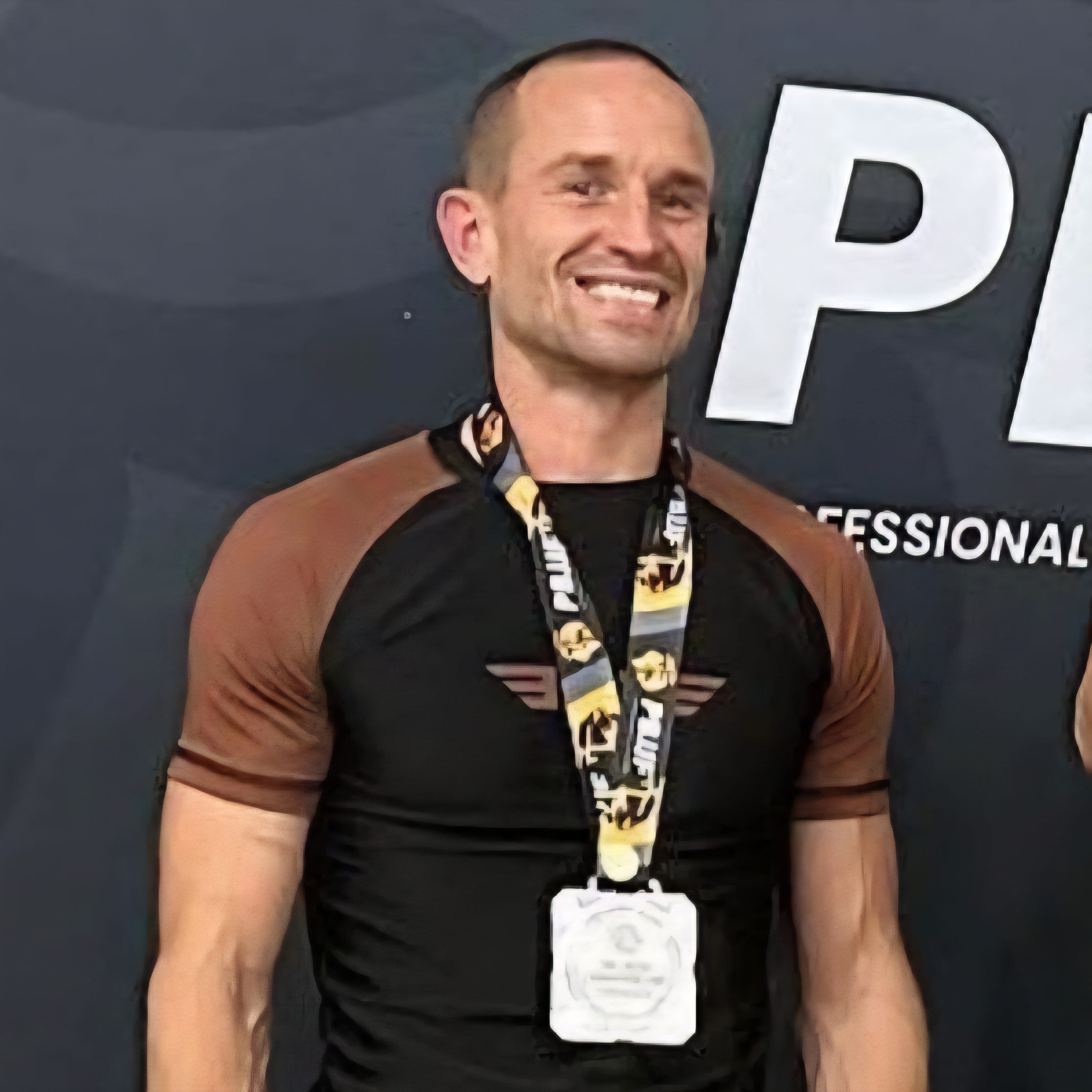
While we have these conversations with our children at their respective levels and in relation to their particular challenges, demonstrating these concepts in our individual lives for our children to witness is even more important. I do my best to bring/involve the kids in all of my extracurriculars whether it’s Brazilian Jiu-Jitsu training/competitions, fitness classes/events, or just running errands around town. I want them to see how I approach physical, mental, and social challenges.
Even when they’re not around, their souls are still with me, making me feel responsible to set the example and meet every challenge with a productive attitude and effort.
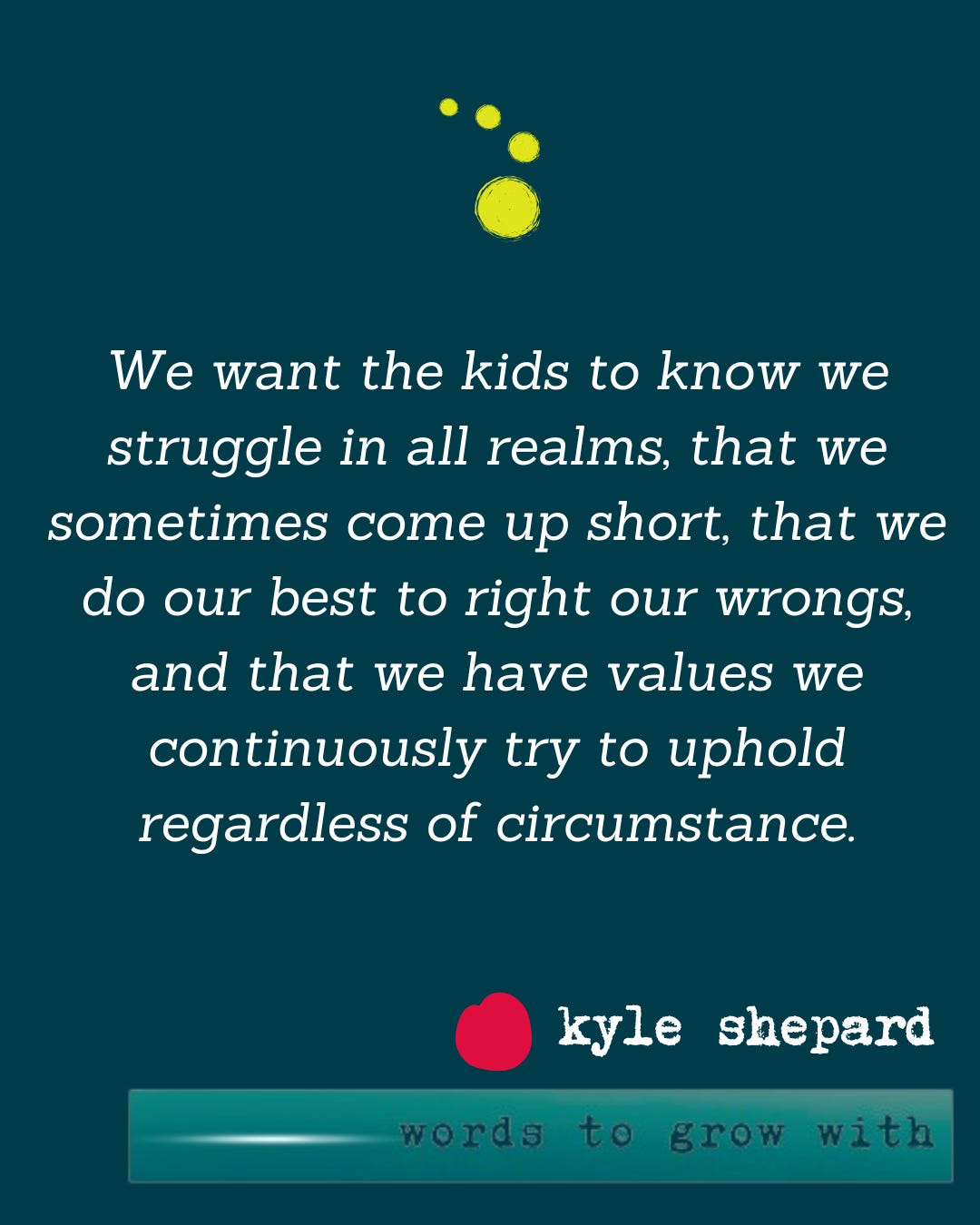
Where MK has helped me improve is sharing stories of my failures and challenges both in the present and past. We want the kids to know we struggle in all realms, that we sometimes come up short, that we do our best to right our wrongs, and that we have values we continuously try to uphold regardless of circumstance. This is where I’m getting better at merging explaining and demonstrating.
If they are only seeing me treat others well despite someone having a hard time, having a good attitude even after a defeat, or experiencing various forms of success in my roles, they’ll have a misguided picture of the work it took and the work I’m still internally putting in to get to where I am today at almost 40 years old.
The interest they show when I share stories of struggle, how I managed or messed up at the time, and my lessons learned always reminds me of the importance in being vulnerable and sharing your losses. This is deeply human and applies well to all ages, especially children as we attempt to mold them into resilient adults.
DANNI: Being this example of deeply human, such a fundamental core value. One of the major things stripping us of being deeply human is the levels of stress we constantly experience. It influences how we function and how we interact with others. Self-regulation is a challenge for most of us. As a resilience instructor, what are your beliefs about this?
KYLE: First, and foremost, I’ve updated my belief about stress. Stress used to be the enemy. Something to avoid or defeat. We all know chronic stress can produce many detrimental effects on our health. Regardless of stressor, the external or internal event leading to stress, your view of it ultimately determines whether or not stress, especially mental, is chronic or not.
A few years ago I learned of the 90-second rule, a phenomenon proposed by Dr. Jill Bolte Taylor, showing the physiologic stress response lasts approximately 90 seconds on average. Anything beyond 90 seconds involves continued mental engagement with stressor through rumination.
An example of this would be my older son, Samuel, loves to try and scare me. He has really gotten me a few times where I unexpectedly am opening my car door when I come home from work or early in the morning when he quietly sneaks downstairs without me knowing he’s awake. When successful, he unquestionably has caused my stress response to spike. Knowing he means no harm, I laugh and don’t think much more on it.
According to the 90-second rule, my body should return to its respective baseline within 90 seconds. Now if I were to be upset with him for scaring me or think there’s something wrong with him for wanting to scare me, I would continue to experience stress well beyond a minute and a half. There will obviously be more severe stressors that require rumination, grief, and continued reflection. This knowledge, however, is empowering when we consider we have a lot of choice in our stress response.
Due to life experience, passion for this area, and continuous learning, I now define stress as a physiologic prediction of or response to things one cares about. The physiology behind stress is part of our human nature which has and continues to allow us to do amazing things like focus, learn, and perform under pressure. It’s imperative to first remove any negative connotations about the acute stress response before one can effectively manage it. Stress is neither good nor bad. Stress simply means you care.
DANNI: Stress simply means you care. What a powerful, tweak. Like grief means you have loved deeply. We still have to work on passing over to a better place, but this type of trust supports us as we do.
What do you suggest for stress management?
KYLE: Once you update your belief about stress, management then requires awareness. You can’t solve or manage problems you aren’t aware of. How much of the day feels like you’re just in a constant stimulus -> response loop? Without conscious thought, we can get trapped into simply relying on our instincts and ingrained patterns to react to the various challenges we encounter. We all have signs and symptoms of the stress response such as changes in breathing, increased heart rate, muscle tension, sweaty palms, stomach butterflies, or negative thinking patterns. Knowing your unique signs of stress allows for early indicators for intervention.
Awareness of stress allows you to determine the best course of action (to include a pause or some form of inaction) prior to response. Stress feels urgent, something we must intervene on and rid our bodies of. While all emergencies are stressors, most stressors are not emergencies. Awareness brings options. I could list out all kinds of management strategies, but I’ll stick with my two favorites: conscious breathing and reframing.
Our autonomic nervous system typically controls our breathing, meaning it’s something that happens without our conscious thought. When stressed, our breathing automatically changes as the brain floods our body with chemicals to prepare us for the stressor. There are many breathing techniques like box breathing, 4-7-8 breathing, or the physiologic sigh, that can be useful tools. But I prefer emphasis on nasal breathing. You can’t hyperventilate through the nose. Once you know you’re stressed, simply begin nasal breathing by taking a deep breath followed by focus on extending your exhalations.
Making your breathing conscious, especially with extending exhales, allows you to activate your parasympathetic nervous system and slow down the stress response in real time.
While consciously breathing, my other favorite strategy of reframing can be implemented in the mind. Regardless of stressor, there are multiple explanations behind why it happened and what our perception of it is. Challenge your assumptions. Make a habit of considering the most charitable interpretation of a stressor, as long as it’s believable, as you consciously breathe and consider your response. Even if you’re wrong, the questioning rather than concluding will aid in decreasing your stress as you determine the best course of action within your control.
Combining conscious breathing and cognitive reframing allows you to physically and mentally regulate your body in real time. These strategies, when implemented early in the stress response, especially for someone who has a nuanced belief about stress, aid in the ability to be resilient regardless of adversity.
DANNI: Do these techniques work with your kids?
KYLE: Yes, we’re seeing these techniques take hold in our children. It all starts with modeling. Anything we say won’t carry much weight unless we are demonstrating the techniques ourselves. MK has been and continues to be the leader in this realm. Watching her explain where she is emotionally during a hard moment, state she is going to take a minute to calm herself down, and then continue to resolve a conflict stoically inspires me to share more in real time rather than focus only on executing.
It’s hard to understand the why if you’re never explaining the how and what. The foundation for self-regulation is breathing. When emotions are running high, we often have to regulate the physiology before we can effectively engage the psychology. We sit with our kids, especially the younger ones, while they’re having a hard time and help them get to the point where they can begin taking deep breaths. Once they’re regulated enough, we can begin effective communication.
It doesn’t always go well, especially when the baby is teething, the 4-yr old is sick, and it’s one of the older ones having a hard time. We know we are planting seeds though. It’s extremely rewarding to watch one of our kids become frustrated with a sibling or something they’re trying to accomplish, then independently step away, take several conscious breaths, and come back with an improved attitude. We see this more frequently in our older kids, where we can now begin asking questions about their initial interpretation of a challenge and whether there might be a different, more charitable interpretation. It’s becoming more common for them to return the favor during our own hard times.
We are continuously learning and teaching one another that we can become frustrated, recognize it, regulate ourself, and then make a reasonable choice. Setting a foundation and building upon it is our goal individually and collectively.
DANNI: I love how all of this is really simple and accessibile to everyone. Unfortunately, most people feel like they do not have time or energy for this type of awareness. But it really is about taking the time to cultivate this awareness that gifts us time and energy to care for every aspect of our life. Another huge challenge is healthy communication. Again, there is this perception that it is too time consuming. We are too tired at the end of the day to get to know and understand one another. As the world rapidly changes it feels harder and harder to communicate, especially with the younger generations who are growing up with short format exchange. How do you enable healthy communication in your home?
KYLE: For any skill you want to improve upon, you need to train that particular skill as often as possible. Unlike physical exertion, which requires recovery time to receive adaptive benefits, we can practice the skill of effective communication in every waking moment. Every interaction is an opportunity to become a better communicator.
MK and I make a point to have deep conversations or disagreements in front of the children. The intent is to allow them to see the respect we maintain for one another while we explore ideas or find common ground. When speaking with the kids, we do the same thing. This doesn’t mean we don’t raise our voices in response to repetitive disobedience or unsafe actions, but we do our best to communicate from a place of reason rather than heightened emotion. Whenever we mess up with an outburst or say something we don’t mean, we are big on owning it, repairing, and working to not let it happen again.
There are two skills I lean on when it comes to any form of communication: self-command and empathy. Self-command, or what others call self-regulation, ties very closely to stress management. If I’m out of control internally, my external actions and words are going to reflect my internal state. The only two things we have control over in this life is our thought interpretation and subsequent action. Thoughts of all kinds are going to come into our heads to include ones we aren’t proud of, especially when emotional. Prior to speaking or communicating in any other modality, ensuring I’m regulated and interpreting my thoughts rationally is essential.
Empathy, the ability to consider the perspective of another, is a phenomenal skill to practice and model. Attempting to understand where someone else is coming from rather than solely focusing on your perspective will connect you with all walks of life. Curiosity quells certainty and encourages respect. Leaning on, modeling, and discussing these skills in our home supports the ongoing effort to develop effective communication, especially for challenging conversations.
DANNI: Our decreasing ability to concentrate and listen due to technology does not help. How do you deal with this?
KYLE: Technology is an obvious contributor in the modern world. We ensure much of the day is technology free while using family meals, walks, car rides, or rest periods as times for discussion. We also love taking the kids on dates either individually or in groups so focused conversations and connection can occur.
DANNI: For most, parenting feels like a continuous repetition of ‘I don’t know’ with a glimpse of confidence peeking in every once in a while. How do you and MK support one another?
KYLE: Many of our date nights, times where we stay up after the kids go to sleep to spend quality time one-on-one, have become like therapy sessions for one another. We talk through the areas of life, often parenting, where we feel like we are messing up and work through why that is. We often help each other reframe or see opportunities to work on so the challenging cycles don’t continue. I value these evenings so much. We get to share our souls while reminding each other we’re a team who is working on growing together. I tell Mary Kate “I just loved you a little more” relatively often. This is always the case after our date nights.
DANNI: I love that you call these date nights. It feels so much better than ‘meetings’. I shared this with my husband. We are both so enthusiastic about making this small mental shift.
It is obvious that you and MK emphasize loving kindness in your home. What is your belief about the importance of discipline in regards to teaching respect and personal responsibility?
KYLE: Every action has a consequence. Consequence, like stress, is a word that often carries a negative connotation. If you consistently lift weights with proper recovery, the consequence is getting stronger. If you lie to someone, the consequence is fractured trust. Consequences are natural by-products of actions.
As parents, MK and I consistently allow the kids to experience natural consequences while also creating consequences appropriate for the actions our kids choose to make (a common topic of discussion during our date nights).
Self-discipline is understanding the consequences of your actions prior to making a choice and making a decision based on your desired end state regardless of difficulty. When we discipline our children, we attempt to explain what we are doing and why, with the intention of building eventual self-discipline.
DANNI: You are right. Words like stress, consequence, also discipline, sacrifice, and responsibility carry emotional weight. If a child only hears a word in a negative way, or as part of a punishment, they instinctively develop an adversion to it. We return to your concept of reframing when we shift the emotional response of a word from something to be scared of to something positive. When we reframe intimidating words for young children, we change how their brains process those concepts; they become positive tools to grow with.
If you could choose only one core value for your kids to master which one would it be, and why?
KYLE: No surprise here, my answer is resilience. Resilience is both a mindset and a skill that can be trained to benefit any domain of life. I define resilience as the ability to effectively function with, recover from, and improve because of stress. Remember, we don’t stress over things we don’t care about. Whatever our children may care about throughout each phase of their life, resilience will allow them to be and continue to grow into the best versions of themselves.
DANNI: If you were to ask your kids, what would they say is the thing you tell them never, ever to forget?
KYLE: After the kids make fun of me for calling everything a mental state and talking about resilience too much, I would think they’d answer to never forget the power of a productive attitude and honesty.
DANNI: Honesty is a priority in our house too. Along with thinking with your own mind and acknowledging when you aren’t. And self-love and kindness, of course. We constantly communicate with one another and work on improving all of this.
Do you agree with the expression, “happy parents make for happy kids”?
KYLE: I think “happy parents make happy kids” is a nice sentiment in that the general mood of others can be contagious. However, I do not believe this statement is a productive orientation. Happiness is a poor objective. Emotions, both perceptually good and bad, are fleeting by-products of experiences and our perceptions of them.
Happiness as a goal implies other emotions should be avoided. I want my children and myself to enjoy life, but I don’t want to create an impression that being happy is the constant objective. Much of my or the world’s greatest accomplishments have come from tremendous struggle, uncertainty, and chaos. Enjoying challenge, finding humor, and smiling despite feeling uncomfortable can all occur in the absence of happiness. Satisfaction or contentment are better objectives when it comes to life fulfillment despite adversity, particularly in the modern world which is abundantly full of ways for instant gratification.
Ultimately, I believe resilient parents make for resilient kids assuming the parents are deeply involved in their children’s development and channeling their wisdom directly to their loved ones.
DANNI: One of my mantras is “wholeness over happiness”. I strive for fullness in my life. Fullness comes from a complete experience - good, bad, and everything in between. What we experience is really our nervous system reacting to the situation. As you said, perception commands - emotions attached to a word, a challenge, the world. Choosing to create fullness is an intentional choice we must faithfully return to, not a result of anything particular that happens or does not happen, not getting what we believe we want. But rather, how can I create goodness from this?
With four kids, alone time must be extremely tough. What do you do to keep intimacy alive as a couple?
KYLE: It’s not the most romantic answer, but we are in a phase of our life where we keep the intimacy alive through planning for and scheduling it. We definitely have nights where we spontaneously decide we miss each other and want to spend quality time during an unplanned date night. Otherwise, we assess everything on our plate and determine when we can block uninterrupted time with one another.
If I were to be forced to say what is the one thing that has improved the most over the course of our relationship, my answer would be our communication. Our ability to check in, share, and discuss how we are planning to individually and collectively accomplish our missions is vastly different from when we first met. Scheduling our alone time has further improved our communication and allowed us to continue prioritizing quality time together through all seasons of life.
DANNI: My husband and I always make sure to program time for only us. Date nights, an overnight getaway, morning coffee. We also use this time to talk. Again, it is all about our perception. When you choose to spend your life together, great communication and commitment is romantic with or without candlelight.
Kyle, you started training in mixed martial arts after you learned you were going to be a father. I see the sweetest desire to prepare and protect here. Franklin D. Roosevelt said, ‘We may not be able to prepare the future for our children, but we can at least prepare our children for the future.’ What are your personal beliefs about the future and how are you preparing your children for it?
KYLE: The future is uncertain. There are reasons to be optimistic and hopeful while there are also reasons to be pessimistic and dreadful. What you focus on, you get more of. This is another mantra we tell our children often. Look for the bad, you’ll find it. Focus on what is in your control and you’ll execute regardless of chaos or uncertainty.
There is much to learn from the past, especially in our individual lives so unproductive patterns do not continuously repeat. We prepare best for the future by reflecting on lessons from the past and creatively considering possibilities of the future to maximize the present.
Preparation, at the individual level, can be approached with a competitive mindset. What can you do today to be a little more capable mentally, physically, socially, or spiritually? Competing with your former self promotes continued improvement regardless of what is going on around you. We can use data from the world to explore directions we want to go, but the goal is to make the most of each day for as long as we can.
We are trying to prepare our kids for the future by systematically building upon their skills and the paths they’re interested in with lived experiences. Embracing the moments, ensuring they know we are always in their corner, and progressively encouraging them to become independent, adaptable, and resilient adults is our strategy for preparing for the future each day.
DANNI: What makes a great parent?
KYLE: I would assume most parents who are involved in their children’s lives give them relatively good information. While children may listen to what their parents say every once in a while, they absolutely watch and absorb what they do in every moment. A great parent attempts to match their actions with their words. They take all of their roles seriously. They set the standard in all domains even when the kids aren’t watching. They continuously work to be the best version of themselves to honor the duty and responsibility behind the most important role in the world - being a parent.
DANNI: Absolutely. For the home, for humanity.
DANNI: How do you hope to be remembered as a dad?
KYLE: I hope the kids remember me as a loving and involved father. Just as, if not more importantly, I hope they remember me as a good husband. In my opinion, if you’re married and have children, it is not possible to be a good parent if you’re not a good spouse. Furthermore, it’s not possible to be a good parent or spouse if you’re not working to be a good human. My personal mission statement is to “be a good husband, father, and man.” All of my choices and actions are influenced by this mission.
DANNI: Any last words?
KYLE: The most important attribute one can possess as a parent, spouse, or person is genuinely caring. Without love, the deepest form of caring, everything else will suffer. With caring comes stress. You’re going to stress over the things you care most about. This is why I’m such a proponent of resilience. Resilience provides the skill to allow you to effectively care for as long as you’re lucky enough to be alive. Make the most of this life by loving deeply and living resiliently.
DANNI: Kyle, thank you! This entire conversation is a constant reminder that small shifts truly matter. We can all make a difference. 🙏.

If you enjoyed this conversation, please subscribe to Kyle & Mary Kate’s Substack, Resilient Mental State.
Let’s keep the conversation going. I can never say this enough - your voice is fundamental here. What is your experience, what core value is most important for you, what resonated the most? Please share.
Important: Read part two of this conversation with Mary Kate Shepard here.
You grow with us. We grow with you. It is so beautiful. xo Danni
Further reading with Kyle
Bare HEARTS because we are so exhausted of holding up the pretty presentation. It is like we are all waiting for someone to come and tell us that it is okay to get super transparent and just be. This is the place. This is our okay. Thank you for joining us. 🙏💝
*this series was inspired by Jane Ratcliffe.
Danni, this is beautifully composed and I so appreciate your thought-provoking questions in this series. I know you know how special life can feel when you’ve chosen the person who challenges you to be your best, not only through their words, but mostly through their actions. That’s definitely who Kyle is for me. Your questions really pulled out the essence of who Kyle is as a man, husband, and father. Looking forward to next week! ❤️😊
Please more posts from you two.